


Page 22 - Katten Kattwalk and Kattison Avenue - Winter 2026 - Issue 5
P. 22
Why Are British Artists Suing a


        British Fashion House Over Graffiti


        on British Buildings, in America?


                                   By Asena Baran and David Halberstadter


                 his case seems so straight-forward that fans
                 of self-effacing legal articles might question
                 why this one is worth the ink. UK-based
        Tgraffiti artists Cole Smith, Reece Deardon
        and Harry Matthews, known professionally as DISA,
        SNOK and RENNEE, respectively, claim that a British
        fashion house, Vivienne Westwood, used images
        of their graffiti to adorn items of clothing without
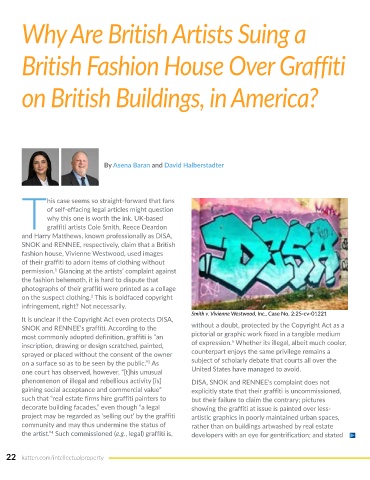
        permission.  Glancing at the artists’ complaint against
                   1
        the fashion behemoth, it is hard to dispute that
        photographs of their graffiti were printed as a collage
        on the suspect clothing.  This is boldfaced copyright
                               2
        infringement, right? Not necessarily.
                                                                Smith v. Vivienne Westwood, Inc., Case No. 2:25-cv-01221
        It is unclear if the Copyright Act even protects DISA,
        SNOK and RENNEE’s graffiti. According to the            without a doubt, protected by the Copyright Act as a
        most commonly adopted definition, graffiti is “an       pictorial or graphic work fixed in a tangible medium
                                                                              5
        inscription, drawing or design scratched, painted,      of expression.  Whether its illegal, albeit much cooler,
        sprayed or placed without the consent of the owner      counterpart enjoys the same privilege remains a
        on a surface so as to be seen by the public.”  As       subject of scholarly debate that courts all over the
                                                  3
        one court has observed, however, “[t]his unusual        United States have managed to avoid.
        phenomenon of illegal and rebellious activity [is]      DISA, SNOK and RENNEE’s complaint does not
        gaining social acceptance and commercial value”         explicitly state that their graffiti is uncommissioned,
        such that “real estate firms hire graffiti painters to   but their failure to claim the contrary; pictures
        decorate building facades,” even though “a legal        showing the graffiti at issue is painted over less-
        project may be regarded as ‘selling out’ by the graffiti   artistic graphics in poorly maintained urban spaces,
        community and may thus undermine the status of          rather than on buildings artwashed by real estate
        the artist.”  Such commissioned (e.g., legal) graffiti is,   developers with an eye for gentrification; and stated
                  4


   22 katten.com/intellectualproperty

