


Page 23 - Katten Kattwalk and Kattison Avenue - Winter 2026 - Issue 5
P. 23
concern about becoming “corporate sellouts, willing     First, as discussed in our introductory Passle post
        to trade their artistic independence, legacy and        about this case, while these artists may pursue their
        credibility for a quick buck” suggest that the graffiti   copyright infringement claims under the Berne
        at issue is in fact illegal.  While there is no precedent   Convention without having registered their tags with
                               6
        on point and legality is not an explicit prerequisite   the United States Copyright Office, they probably
        for protection under the Copyright Act, courts have     are not entitled to recover either statutory damages
        suggested that an illegal work may not be entitled      or attorneys’ fees without registrations in the United
        to copyright protection under the laws of the United    States.
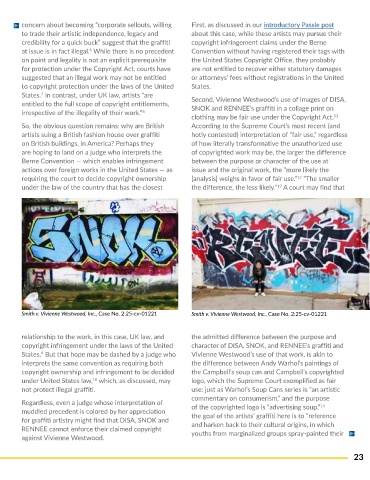
        States.  In contrast, under UK law, artists “are        Second, Vivienne Westwood’s use of images of DISA,
               7
        entitled to the full scope of copyright entitlements,
        irrespective of the illegality of their work.”          SNOK and RENNEE’s graffiti in a collage print on
                                                8
                                                                clothing may be fair use under the Copyright Act.
                                                                                                               11
        So, the obvious question remains: why are British       According to the Supreme Court’s most recent (and
        artists suing a British fashion house over graffiti     hotly contested) interpretation of “fair use,” regardless
        on British buildings, in America? Perhaps they          of how literally transformative the unauthorized use
        are hoping to land on a judge who interprets the        of copyrighted work may be, the larger the difference
        Berne Convention — which enables infringement           between the purpose or character of the use at
        actions over foreign works in the United States — as    issue and the original work, the “more likely the
        requiring the court to decide copyright ownership       [analysis] weighs in favor of fair use.”  “The smaller
                                                                                                   12
        under the law of the country that has the closest       the difference, the less likely.”  A court may find that
                                                                                             13


        Smith v. Vivienne Westwood, Inc., Case No. 2:25-cv-01221  Smith v. Vivienne Westwood, Inc., Case No. 2:25-cv-01221


        relationship to the work, in this case, UK law, and     the admitted difference between the purpose and
        copyright infringement under the laws of the United     character of DISA, SNOK, and RENNEE’s graffiti and
        States.  But that hope may be dashed by a judge who     Vivienne Westwood’s use of that work, is akin to
               9
        interprets the same convention as requiring both        the difference between Andy Warhol’s paintings of
        copyright ownership and infringement to be decided      the Campbell’s soup can and Campbell’s copyrighted
        under United States law,  which, as discussed, may      logo, which the Supreme Court exemplified as fair
                                10
        not protect illegal graffiti.                           use: just as Warhol’s Soup Cans series is “an artistic
                                                                commentary on consumerism,” and the purpose
        Regardless, even a judge whose interpretation of                                                   14
        muddled precedent is colored by her appreciation        of the copyrighted logo is “advertising soup,”
                                                                the goal of the artists’ graffiti here is to “reference
        for graffiti artistry might find that DISA, SNOK and
        RENNEE cannot enforce their claimed copyright           and harken back to their cultural origins, in which
                                                                youths from marginalized groups spray-painted their
        against Vivienne Westwood.

                                                                                                                      23

