


Page 15 - Kattison Avenue Newsletter - Spring 2026 - Issue 16
P. 15
The law provides a carve-out for entities (including affiliates)
         with  under  $1  million  in  annual  global  turnover  and  for   UK-Based Graffiti Artists
         exclusive sellers  of secondhand apparel or textiles,  while
         allowing  any  producer  identified  within  the  definition  to   Dismiss Their US Lawsuit
         assume producer responsibility, thereby “relieving from those   Against Vivienne Westwood
         duties and liabilities any other person who manufactures,
         distributes, imports, offers for sale, or sells the covered
         product.” Fashion businesses, therefore, may need to revisit
                                                                                    By David Halberstadter and Asena Baran
         their licensing and distribution agreements to explicitly assign
         producer responsibility to one entity along the California
         supply chain.
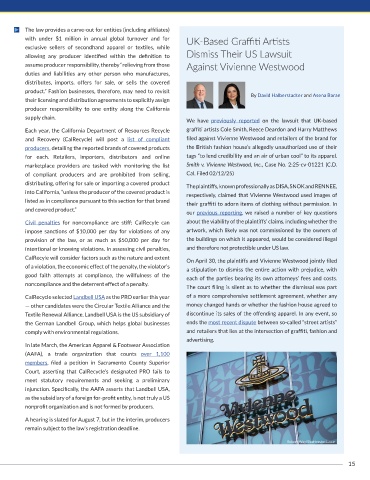
                                                               We have  previously reported on the lawsuit that UK-based
         Each year, the  California Department of Resources  Recycle   graffiti artists Cole Smith, Reece Deardon and Harry Matthews
         and  Recovery  (CalRecycle)  will  post  a  list of compliant   filed against Vivienne Westwood and retailers of the brand for
         producers, detailing the reported brands of covered products   the British fashion house’s allegedly unauthorized use of their
         for each. Retailers, importers, distributors and online   tags “to lend credibility and an air of urban cool” to its apparel.
         marketplace  providers are tasked with monitoring the  list   Smith v. Vivienne Westwood, Inc., Case No. 2:25-cv-01221 (C.D.
         of compliant  producers and are  prohibited from selling,   Cal. Filed 02/12/25)
         distributing, offering for sale or importing a covered product
                                                               The plaintiffs, known professionally as DISA, SNOK and RENNEE,
         into California, “unless the producer of the covered product is
                                                               respectively, claimed that Vivienne Westwood used images of
         listed as in compliance pursuant to this section for that brand
                                                               their graffiti to adorn items of clothing without permission. In
         and covered product.”
                                                               our  previous reporting,  we  raised  a  number  of  key  questions
         Civil penalties for noncompliance are stiff: CalRecyle can   about the viability of the plaintiffs’ claims, including whether the
         impose  sanctions  of  $10,000  per  day  for  violations  of  any   artwork, which likely was not commissioned by the owners of
         provision  of  the  law,  or  as  much  as  $50,000  per  day  for   the buildings on which it appeared, would be considered illegal
         intentional or knowing violations. In assessing civil penalties,   and therefore not protectible under US law.
         CalRecyle will consider factors such as the nature and extent
                                                               On April 30, the plaintiffs and Vivienne Westwood jointly filed
         of a violation, the economic effect of the penalty, the violator’s
                                                               a stipulation  to dismiss  the entire action  with prejudice,  with
         good faith attempts at compliance, the willfulness of the
                                                               each of the parties bearing its own attorneys’ fees and costs.
         noncompliance and the deterrent effect of a penalty.
                                                               The court filing is silent as to whether the dismissal was part
         CalRecycle selected Landbell USA as the PRO earlier this year   of a more comprehensive settlement agreement, whether any
         — other candidates were the Circular Textile Alliance and the   money changed hands or whether the fashion house agreed to
         Textile Renewal Alliance. Landbell USA is the US subsidiary of   discontinue its sales of the offending apparel. In any event, so
         the  German  Landbell  Group,  which  helps  global  businesses   ends the most recent dispute between so-called “street artists”
         comply with environmental regulations.                and retailers that lies at the intersection of graffiti, fashion and
                                                               advertising.
         In late March, the American Apparel & Footwear Association
         (AAFA),  a  trade  organization  that  counts  over 1,100
         members,  filed  a  petition  in  Sacramento  County  Superior
         Court, asserting that CalRecycle’s designated PRO fails to
         meet  statutory  requirements  and  seeking  a  preliminary
         injunction. Specifically, the AAFA asserts that Landbell USA,
         as the subsidiary of a foreign for-profit entity, is not truly a US
         nonprofit organization and is not formed by producers.

         A hearing is slated for August 7, but in the interim, producers
         remain subject to the law’s registration deadline.

                                                                                                Robert Way/Shutterstock.com


                                                                                                                    15

