


Page 8 - Kattison Avenue Newsletter - Spring 2026 - Issue 16
P. 8
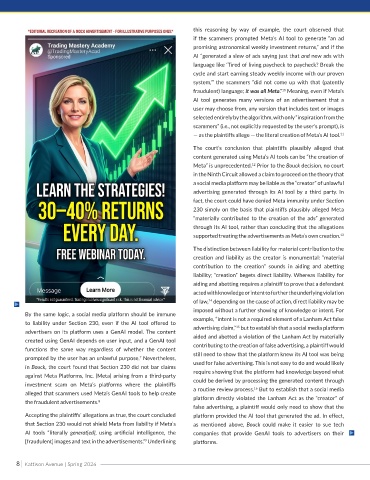
this reasoning by way of example, the court observed that
                                                                 if  the  scammers  prompted  Meta’s  AI  tool  to  generate  “an  ad
                                                                 promising astronomical weekly investment returns,” and if the
                                                                 AI “generated a slew of ads saying just that and new ads with
                                                                 language like ‘Tired of living paycheck to paycheck? Break the
                                                                 cycle and start earning steady weekly income with our proven
                                                                 system,’”  the  scammers  “did  not  come  up  with  that  (patently
                                                                 fraudulent) language; it was all Meta.”  Meaning, even if Meta’s
                                                                                              10
                                                                 AI tool generates many versions of an advertisement that a
                                                                 user may choose from, any version that includes text or images
                                                                 selected entirely by the algorithm, with only “inspiration from the
                                                                 scammers” (i.e., not explicitly requested by the user’s prompt), is
                                                                                                                  11
                                                                 — as the plaintiffs allege — the literal creation of Meta’s AI tool.
                                                                 The court’s conclusion that plaintiffs plausibly alleged that
                                                                 content generated using Meta’s AI tools can be “the creation of
                                                                                    12
                                                                 Meta” is unprecedented.  Prior to the Bouck decision, no court
                                                                 in the Ninth Circuit allowed a claim to proceed on the theory that
                                                                 a social media platform may be liable as the “creator” of unlawful
                                                                 advertising generated through its AI tool by a third party. In
                                                                 fact, the court could have denied Meta immunity under Section
                                                                 230 simply on the basis that plaintiffs plausibly alleged Meta
                                                                 “materially  contributed  to  the  creation  of  the  ads”  generated
                                                                 through its AI tool, rather than concluding that the allegations
                                                                                                                  13
                                                                 supported treating the advertisements as Meta’s own creation.
                                                                 The distinction between liability for material contribution to the
                                                                 creation  and  liability  as  the  creator  is  monumental:  “material
                                                                 contribution  to  the  creation”  sounds  in  aiding  and  abetting
                                                                 liability;  “creation”  begets  direct  liability.  Whereas  liability  for
                                                                 aiding and abetting requires a plaintiff to prove that a defendant
                                                                 acted with knowledge or intent to further the underlying violation
                                                                 of law,  depending on the cause of action, direct liability may be
                                                                      14
                                                                 imposed without a further showing of knowledge or intent. For
         By  the  same  logic,  a  social media  platform  should be  immune
                                                                 example, “intent is not a required element of a Lanham Act false
         to liability under Section 230, even if the AI tool offered to
                                                                 advertising claim,”  but to establish that a social media platform
                                                                               15
         advertisers  on  its  platform  uses  a  GenAI  model.  The  content
                                                                 aided and abetted a violation of the Lanham Act by materially
         created using GenAI depends on user input, and a GenAI tool
                                                                 contributing to the creation of false advertising, a plaintiff would
         functions the same way regardless of whether the content
                                                                 still need to show that the platform knew its AI tool was being
         prompted by the user has an unlawful purpose.  Nevertheless,
                                               7
                                                                 used for false advertising. This is not easy to do and would likely
         in  Bouck, the court found that Section 230 did not bar claims
                                                                 require showing that the platform had knowledge beyond what
         against  Meta  Platforms,  Inc.  (Meta)  arising  from  a  third-party
                                                                 could be derived by processing the generated content through
         investment scam on Meta’s platforms where  the plaintiffs
                                                                 a routine review process.  But to establish that a social media
                                                                                     16
         alleged that scammers used Meta’s GenAI tools to help create
                                                                 platform  directly  violated  the  Lanham  Act  as  the  “creator”  of
         the fraudulent advertisements.
                                  8
                                                                 false advertising, a plaintiff would only need to show that the
         Accepting the plaintiffs’ allegations as true, the court concluded   platform provided the AI tool that generated the ad. In effect,
         that Section 230 would not shield Meta from liability if Meta’s   as  mentioned  above,  Bouck  could  make  it  easier  to  sue  tech
         AI  tools  “literally  generat[ed],  using  artificial  intelligence,  the   companies  that  provide  GenAI  tools  to  advertisers  on  their
         [fraudulent] images and text in the advertisements.”  Underlining   platforms.
                                                 9
      8 Kattison Avenue | Spring 2026

