


Page 9 - Katten Kattwalk and Kattison Avenue - Winter 2026 - Issue 5
P. 9
“New York has always been a home for artists, and       Andersson, the company’s chief creative officer, in a
        today it stands as a model for how to safeguard not     LinkedIn post at the time.
        only our members, but the broader public,” observed     New York State legislators have been actively ex-
        SAG-AFTRA New York Local President Ezra Knight in
        response to the new legislation.                        ploring ways to curtail potential misuses of AI at the
                                                                development stage as well. On December 19, 2025,
        Assembly Member Linda Rosenthal, a co-sponsor of        Governor Hochul signed into law the Responsible AI
        the bill, said in a statement that the “proliferation of   Safety and Education Act (RAISE Act), which takes
        deepfakes and other artificial intelligence has blurred   effect on January 1, 2027. The legislation applies to
        the lines between the digital world and reality” in     companies with over $500 million in annual revenue,
        harmful ways. “Consumers have a right to know if the    requiring them to adhere to certain AI-development
        product or service being advertised to them is by a real
        person or a computer-generated avatar,” she added.
        “The reduced production costs for companies using AI
        is not worth the hefty price of obscuring reality.”
        Relatedly, Senate Bill 8420-A, which will be effective
        in June 2026, requires advertisers to conspicuously
        disclose the known use of “synthetic performers”
        in commercial advertisements, with a civil penalty
        of $1,000 for a first violation and $5,000 per
        subsequent violation. A “synthetic performer” is
        defined as “a digital asset that is created, reproduced,
        or modified by computer, using generative artificial
        intelligence or a software algorithm, that is intended
        to give the impression that the asset is in an audio,
        audiovisual, and/or visual performance of a human
        performer when it is not recognizable as any
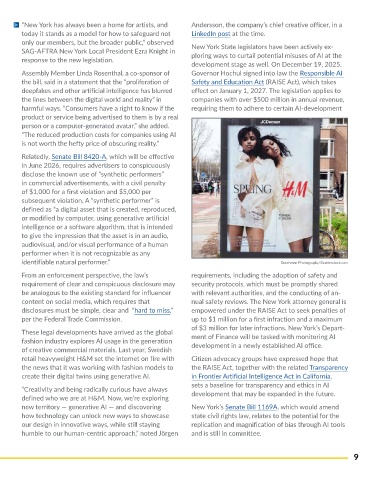
        identifiable natural performer.”                                                      Dutchmen Photography/Shutterstock.com

        From an enforcement perspective, the law’s              requirements, including the adoption of safety and
        requirement of clear and conspicuous disclosure may     security protocols, which must be promptly shared
        be analogous to the existing standard for influencer    with relevant authorities, and the conducting of an-
        content on social media, which requires that            nual safety reviews. The New York attorney general is
        disclosures must be simple, clear and  “hard to miss,”   empowered under the RAISE Act to seek penalties of
        per the Federal Trade Commission.                       up to $1 million for a first infraction and a maximum
                                                                of $3 million for later infractions. New York’s Depart-
        These legal developments have arrived as the global
        fashion industry explores AI usage in the generation    ment of Finance will be tasked with monitoring AI
                                                                development in a newly established AI office.
        of creative commercial materials. Last year, Swedish
        retail heavyweight H&M set the internet on fire with    Citizen advocacy groups have expressed hope that
        the news that it was working with fashion models to     the RAISE Act, together with the related Transparency
        create their digital twins using generative AI.         in Frontier Artificial Intelligence Act in California,
                                                                sets a baseline for transparency and ethics in AI
        “Creativity and being radically curious have always
        defined who we are at H&M. Now, we’re exploring         development that may be expanded in the future.
        new territory — generative AI — and discovering         New York’s Senate Bill 1169A, which would amend
        how technology can unlock new ways to showcase          state civil rights law, relates to the potential for the
        our design in innovative ways, while still staying      replication and magnification of bias through AI tools
        humble to our human-centric approach,” noted Jörgen     and is still in committee.


                                                                                                                      9

