


A first-in-the-nation textile law asks brands a deceptively simple question: who, exactly, is responsible for what we throw away?
Fashion has always been fluent in the language of the new: new seasons, new silhouettes and new drops. What the industry has been slower to talk about is what happens to the old: the mountain of discarded clothing, footwear and household textiles that ends up in landfills each year. California has now decided to make that conversation mandatory. With SB 707, the Responsible Textile Recovery Act of 2024 (Act), the state has enacted the nation's first extended producer responsibility (EPR) law written specifically for textiles.1 Signed by Governor Newsom on September 28, 2024, the Act makes California the first US state to hold the makers and sellers of clothing accountable for the full life cycle of what they put into the market.
For fashion and luxury brands, this is not a far-off policy question. The first compliance deadline of July 1, 2026, has already passed, requiring producers to join the approved Producer Responsibility Organization (PRO).
From Runway to Recovery
The premise of EPR is straightforward, even if its mechanics are not: the companies that profit from putting products into the market should help pay for collecting, sorting and recycling them once consumers are done. SB 707 applies that logic to textiles for the first time, requiring producers to fund and participate in the collection, sorting, repair, reuse and recycling infrastructure for post-consumer textiles.2 The program is administered and enforced by CalRecycle, the California Department of Resources Recycling and Recovery.3
At the center of the plan sits the Producer Responsibility Organization, or PRO, which is a 501(c)(3) nonprofit formed by producers to manage compliance collectively.4 The PRO serves as the vehicle that will establish collection sites, oversee sorting, repair and recycling operations, set eco-modulated fees and report back to CalRecycle.5 The Act required all producers of covered textile products to join the approved PRO by July 1 of this year.6
What's in the Closet?
The Act reaches further into the wardrobe than one might expect. It covers both "apparel" and "textile articles," each defined by a specific statutory list.7 Apparel includes clothing, footwear, handbags, backpacks, and knitted or woven accessories,8 much of the core inventory of any fashion house. "Textile articles" are also included, such as blankets, curtains, towels, bedding, tablecloths, napkins, linens and pillows, so long as the item is made entirely or primarily from a natural, artificial or synthetic fiber, yarn or fabric.9
There are, however, meaningful edges to the law. Products that are predominantly non-textile, such as foam, rubber or plastic, may fall outside the definition even if they resemble something on the list.10 The Act also carves out products already covered by other California stewardship programs, such as mattresses, e-waste and carpets;11 military and health or environmental PPE;12 and secondhand-only sellers.13 Further, in a nod to the smallest players, producers with less than $1,000,000 in annual aggregate global turnover, including affiliates, are exempt entirely.14
The Waterfall: Who Is the 'Producer'?
For global brands, this is the part of the Act that demands the closest reading. SB 707 does not spread responsibility evenly across the supply chain. Instead, it assigns it through a hierarchical "waterfall," in which only one entity is the "producer" for any given covered product.15 Crucially, the hierarchy turns on whether there is a qualifying person "in the state;" that is, in California itself, not just somewhere in the United States.
The tiers cascade in order of priority, as shown below:
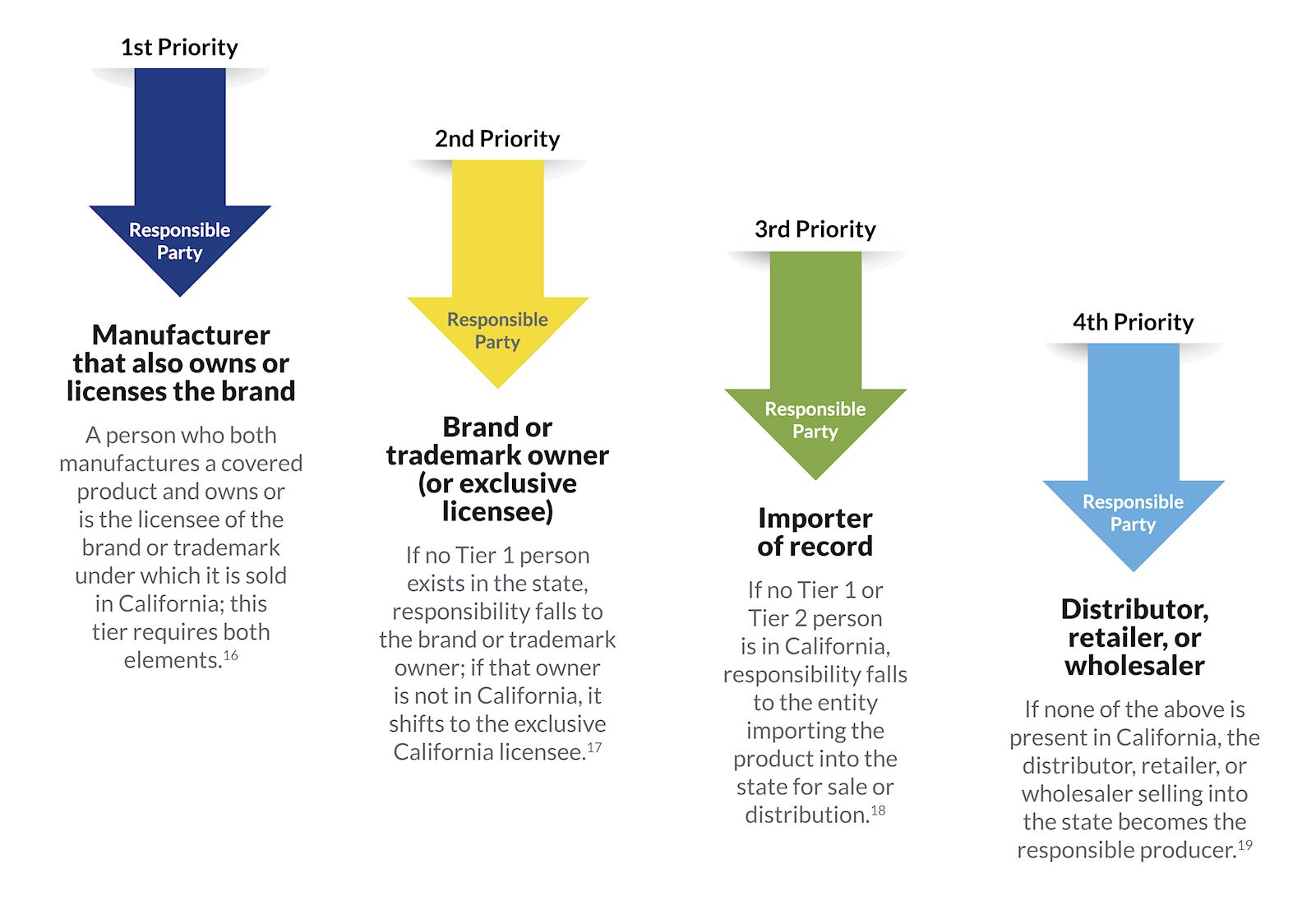
For international and luxury houses, the practical takeaway is that geography does not confer immunity. A brand headquartered outside California may nevertheless qualify as the responsible producer if it, or another qualifying entity within the applicable tier of the statutory waterfall, is "in the state." Whether a subsidiary, office or other California presence satisfies that requirement depends on the particular corporate structure and statutory definition. Plus, a sale is deemed to occur in California whenever the product is delivered to a California consumer.20 Only if no qualifying Tier 1 person is present in the state does the obligation cascade down to the brand owner, then to the exclusive licensee, then to the importer, and finally to the distributor or retailer.
The Answer May Be in Your License Agreements
Because the waterfall depends on who sits where, a brand's licensing structure frequently decides the outcome. If a brand licenses its trademark exclusively to a California entity, that exclusive licensee may become the responsible producer under Tier 2, provided no Tier 1 manufacturer or brand owner sits in California.21 Where a brand has spread its trademark across multiple non-exclusive licensees, the exclusive-licensee tier may not apply at all, and the importer may end up holding the obligation instead.
The most consequential feature of the Act, however, may be its flexibility. The statute expressly permits any person in the supply chain to contractually assume some or all of the statutory producer's duties and liabilities, relieving the statutory producer of those obligations. The parties may contractually allocate some or all of the statutory producer's duties and liabilities, as the Act expressly permits. For clients who are simultaneously licensors and licensees across a portfolio of brands, this means compliance responsibility can, and should, be addressed directly in license agreements. The smart move is to negotiate and document up front which entity will bear registration, fee payment and data-reporting duties, rather than wait and discover where one lands in the statutory order.
The Price of Doing Nothing
The Act gives CalRecycle authority to impose substantial civil penalties for noncompliance. Violations are subject to penalties of up to $10,000 per day, which increase to up to $50,000 per day for knowing or intentional violations. Those penalties become available upon approval of the producer responsibility organization's plan or July 1, 2030, whichever is earlier.
The sharper edge, though, is market access. Once CalRecycle publishes its compliance list, expected no earlier than July 2028 after regulations take effect,22 retailers, distributors and online marketplaces will be prohibited from selling products from noncompliant producers.23 The effect is to bar noncompliant brands from the California market altogether. For good measure, the Act also requires online marketplaces to report every third-party seller with more than $1,000,000 in covered product sales annually to CalRecycle.24 In a state that, on its own, is one of the largest consumer economies in the world, losing the ability to sell there is not a consequence any brand can afford.
The Afterlife of a Garment
California has, in effect, posed a question to the fashion industry that it has long left unspoken: who owns the afterlife of a garment? With SB 707, the state has written its own answer into law, and the rest of the country is watching. Textiles are the first of what will likely be many industries asked to account for what happens after the sale, and California has a habit of setting the standard others eventually follow. The runway, it turns out, does not end at the register.
*Allison Adler, a 2026 Katten summer associate, contributed to this article.
1 Cal. Pub. Res. Code § 42984 (West 2025).
2 Cal. Pub. Res. Code § 42984.4(a)(1) (West 2025).
3 Cal. Pub. Res. Code § 42984.3(j) (West 2025).
4 Cal. Pub. Res. Code § 42984.3(t) (West 2025).
5 Cal. Pub. Res. Code §§ 42984.7, 42984.14, 42984.17 (West 2025).
6 Cal. Pub. Res. Code § 42984.4(a)(1) – (3) (West 2025).
7 Cal. Pub. Res. Code § 42984.3(i)(1) (West 2025).
8 Cal. Pub. Res. Code § 42984.3(a)(1) (West 2025).
9 Cal. Pub. Res. Code § 42984.3(ae) (1) (West 2025).
10 Cal. Pub. Res. Code § 42984.3(a)(1), (ae) (1) (West 2025).
11 Cal. Pub. Res. Code § 42984.3(i)(2)(A) – (C) (West 2025).
12 Cal. Pub. Res. Code § 42984.3(a)(2)(A) – (B) (West 2025).
13 Cal. Pub. Res. Code § 42984.3(s)(7) (West 2025).
14 Cal. Pub. Res. Code § 42984.3(s)(8) (West 2025).
15 Cal. Pub. Res. Code § 42984.3(s)(1) – (4) (West 2025).
16 Cal. Pub. Res. Code § 42984.3(s)(1) (West 2025).
17 Cal. Pub. Res. Code § 42984.3(s)(2) (West 2025).
18 Cal. Pub. Res. Code § 42984.3(s)(3) (West 2025).
19 Cal. Pub. Res. Code § 42984.3(s)(4) (West 2025).
20 Cal. Pub. Res. Code § 42984.3(s)(5) (West 2025).
21 Cal. Pub. Res. Code § 42984.3(s)(2) (West 2025).
22 Cal. Pub. Res. Code § 42984.2 (West 2025).
23 Cal. Pub. Res. Code § 42984.20(c)(2) (West 2025).
24 Cal. Pub. Res. Code § 42984.27(a)(1) (West 2025).

Related Professionals
-
 Partner and National Co-Chair, Trademark/Copyright/Privacy Group+1.212.940.8554
 New York

